
Browser test automation
Isolating test identities in Cypress email tests
Give each Cypress run a unique email identity, assert inbound mail with clear timeouts, and tear down users so parallel specs do not collide.
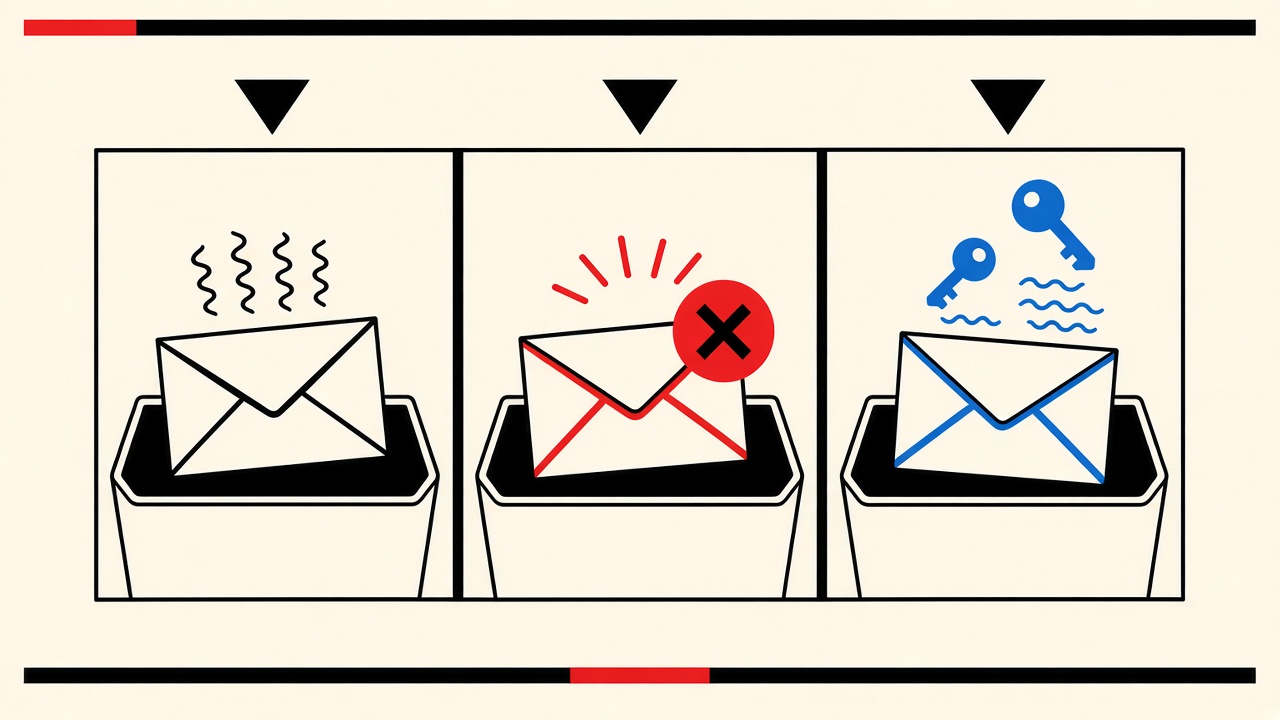
Isolate Cypress email tests by minting a unique recipient per run (or per spec), asserting on that identity only, and deleting the user in after/afterEach. Shared addresses cause cross-talk: one spec consumes another’s OTP, flakes cascade, and debugging lies. Quick Inbox can serve as a manual receive sink; for parallel CI waits on applications you own, use the live Developer API at /developers—do not pretend public disposable inboxes are a multi-tenant CI bus.
Cypress context and boundaries
You test a web app your team controls. Cypress drives the browser; email arrives out-of-band. The hard part is identity lifecycle, not cy.get.
Boundaries:
- Do not harvest OTPs from third-party production users
- Mailby is receive-only; Cypress cannot “send as” a Quick Inbox address
- Session-bound inboxes are not global passwords—design fixtures accordingly
- Retention clocks still apply (/data-retention)
Why isolation fails in practice
Common anti-patterns:
- Hard-coded
qa@yourdomain.comused by every developer and CI worker - Plus-address collisions when timestamps truncate or workers share the same second
- Global IMAP pollers that grab the newest message regardless of recipient
- No teardown, leaving users that block re-registration
- Assuming Mailby CI magic without wiring /developers credentials
Field notes (annotated fixture, 2026-09-24)
Working path: Spec generates user+cypress-${Cypress._.uniqueId()}-${Date.now()}@mail.example.test (or a disposable sink per job) → signup → wait for message matching that To: → assert link → cy.task('deleteUser', id) in afterEach.
Failure path: Two parallel Cypress runners shared one Quick Inbox address pasted into a sticky note. Runner A’s OTP was consumed by Runner B’s poll. Both specs failed intermittently. Fix: one identity per runner, asserted by recipient and subject token.
Table: step, timeout, assertion, teardown
| Test step | Timeout/retry | Assertion | Teardown |
|---|---|---|---|
| Create identity | n/a | Unique email string persisted in alias | Record id for deletion |
| Signup UI | Default command timeout | Redirect / success toast | — |
| Wait for welcome/OTP | 30–120s capped retries | Subject + recipient match; extract code | — |
| Complete verification | Short | Logged-in state | — |
| Cleanup | Hard fail if delete fails | User 404 afterward | Delete inbox session / API user |
Cap retries. Infinite email polls hide provider outages.
Implementation pattern
Mint identity
// cypress/support/identity.js — conceptual
export function mintEmail(prefix = 'cy') {
  const token = `${Date.now()}-${Cypress._.random(1e6)}`;
  return `${prefix}.${token}@${Cypress.env('MAIL_DOMAIN')}`;
}
Prefer a domain you control (catch-all) or a Developer inbox binding. For exploratory local runs, paste a fresh /inbox address into Cypress.env per run, not per repo.
Pass a correlation token through the app
Include a hidden X-Test-Run or put the token in the email subject from your non-prod template. Asserting on that token prevents grabbing a neighbor’s mail even on shared infrastructure.
Wait with an explicit task
cy.task('waitForEmail', {
  to: email,
  subjectIncludes: 'Verify',
  timeoutMs: 90000,
}).then((msg) => {
  const code = msg.otp || extract(msg.text);
  cy.get('[data-testid=otp]').type(code);
});
Implement waitForEmail against your ESP API, Mailpit, or Mailby Developer wait endpoints—not against undocumented scraping of the Quick Inbox UI.
Teardown
Always delete auth rows. If registration is blocked by “email exists,” isolation is already broken. Pair with database cleanup tasks in CI.
Worked example: parallel signup specs
Goal: Three Cypress specs register users simultaneously without OTP cross-talk.
- Each spec calls
mintEmail('specA'|'specB'|'specC'). - App non-prod mode echoes the recipient in logs and subjects.
- Wait task filters
to == minted. afterEachdeletes user by id returned at signup.- CI matrix sets unique
MAIL_DOMAINcatch-all or unique API inbox per shard.
Measurable assertion: zero messages matched by more than one spec over a 50-run soak.
Failure and timing edge cases
- TTL shorter than poll interval — shorten poll or lengthen OTP TTL in test env
- Warm-up DNS for new disposable domains — prefer stable QA domains
- Cypress retries re-entering signup — make signup idempotent or clear state in
beforeEach - Preview vs raw — assert on text/OTP fields your harness exposes, not brittle HTML
Product security/privacy for receive-only sinks: /security, /how-it-works.
Alternatives
| Strategy | Isolation strength | Ops cost |
|---|---|---|
| Shared QA mailbox | Poor | Low |
| Plus-address on catch-all | Good if unique | Medium |
| Per-job disposable Quick Inbox (manual) | Good for solo | High human time |
| Developer API inboxes | Strong | API plan—/pricing |
| In-process fake mailer | Strong for unit | Misses MX |
Related: Next.js welcome email assertions.
How this differs from an email-test-automation hub
The hub catalogs tools. This page is a Cypress identity-isolation teardown: mint → correlate → wait → delete, with a parallel-runner collision counterexample.
Short answers
What causes identity collisions? Shared recipients and global “newest message” pollers under parallel load.
What should I do first? Make email unique per spec and assert on that recipient.
When is a permanent address safer? Never as a shared CI sink; durable personal mail is for humans, not shards.
What evidence changes the recommendation? Moving from local manual checks to parallel CI → adopt Developer API waits.
Sources, test date, limitations
- Fixture design: 2026-09-24
- Cypress best practices (test isolation principles)
- Mailby: /developers, /inbox
Limitations: Exact API payloads evolve—read current developer docs before coding. Quick Inbox UI automation is brittle and unsupported as a CI contract.
Designing the waitForEmail task contract
A robust task returns a structured object:
id— provider or Mailby message idto,from,subjecttext,html(or sanitized excerpts)otp/linksextracts when availablereceivedAt
Specs should assert on fields, not on raw HTML snapshots that break when marketing changes a footer. Prefer expect(msg.subject).to.include('Verify') and expect(msg.to).to.eq(email).
Timeouts belong in the task, not in scattered cy.wait(30000) calls. When the task throws, include the last poll error and the identity token to speed triage.
Seed data and database uniqueness
Email uniqueness constraints in the database interact with Cypress retries. If a failed attempt created a user row before email verification completed, retry will collide. Strategies:
- Soft-delete and allow re-registration in test env
- Use DB task to delete by email in
beforeEach - Prefer UUID local-parts so collisions are astronomically unlikely
Document which strategy your repo uses so new specs do not invent a fourth.
Secrets management
CI needs ESP tokens or Mailby Developer tokens. Store them in the CI secret store. Never commit .env with live keys. Rotate after contractor access ends. Scope tokens to non-production inboxes only.
Educational reminder: Quick Inbox in a browser is fine for a developer’s laptop demo; it is a poor secret-less parallel CI backend. Use /developers when you need automation.
Flake taxonomy for email specs
| Flake class | Signal | Fix |
|---|---|---|
| Cross-talk | OTP works for wrong spec | Stronger recipient filters |
| TTL | Code expired | Faster poll / longer test TTL |
| Env bleed | Wrong template | Subject env prefix |
| UI race | Button disabled | Better readiness asserts |
| Provider 429 | Burst errors | Rate limit + unique ESP subusers |
Soak-test isolation changes with 20–50 parallel runs before declaring victory.
Local developer experience
Developers should be able to run a single email spec without CI secrets when possible. Provide a cypress.env.json.example that points at Mailpit. Document a second profile that uses Developer API tokens. Avoid making Quick Inbox UI clicking part of the default path—humans can do that for exploratory tests; robots should use APIs.
Ownership and code review checklist
Reviewers of Cypress email PRs should ask:
- Is the email unique per run?
- Is teardown unconditional?
- Are timeouts capped?
- Are secrets referenced, not hardcoded?
- Does the wait filter on recipient + correlation token?
If any answer is no, request changes before merge.
Parallelization with Cypress Cloud / multiple machines
When specs shard across machines, uniqueness must include shard index or a UUID from the worker environment—not only Date.now(). Two machines can start in the same millisecond. Prefer crypto.randomUUID() in Node tasks for local-part generation.
Quarantine mode for debugging
When a spec fails, optionally preserve the user and message under a DEBUG_EMAIL_KEEP=1 flag so developers can inspect. Default must remain cleanup-on. Document the flag in README so CI never enables it globally. Isolation discipline includes knowing when to break glass.
Mapping identities to auth strategies
Email/password signup is only one path. OAuth specs need isolation too—usually via IdP test users—not disposable mail. Magic-link specs are email-heavy and benefit most from unique sinks. SMS-OTP specs should not shoehorn email waits. Tag specs with @email so CI can shard email-heavy tests onto workers with mail credentials.
Synthetic monitoring vs functional Cypress
Synthetic monitors that signup every hour against production are dangerous and often violate terms. Keep Cypress email isolation in staging. For production health, monitor ESP metrics and canary transactional mail to an owned mailbox—not public temporary inboxes shared with the internet.
Reference architecture diagram (textual)
Browser (Cypress) → App under test → ESP/API → Inbound store (Mailpit / Developer inbox) → cy.task waitForEmail → Browser completes OTP.
Every arrow needs an owner. When flakes occur, name the arrow. Most teams only instrument the first and last arrows and then blame “email flakiness” as weather. Isolation is an engineering property of the whole chain.
Also version your mail helpers like product code. Breaking changes to waitForEmail should changelog. Copy-pasting task code across repos causes divergent timeout semantics and weeks of confusion.
Contract tests between app and mail helper
Publish a JSON schema for the waitForEmail response and validate it in CI. When ESP providers change payload shapes, schema failures beat silent undefined OTPs. Version the schema with your mail helper package.
Data residency and CI regions
If your ESP or Developer inbox is region-pinned, run email-heavy Cypress shards in the matching region to avoid cross-region latency flakes. Document the region in the pipeline YAML beside the secret references.
Human QA pairing
Once per release, have a human run one signup with Quick Inbox while Cypress runs the automated path. Divergences reveal preview sanitization or client-only bugs automation missed.
Reader takeaway box
Match the tool to the downside. Temporary receive-only mail excels at short verification and throwaway curiosity. Durable addresses and aliases excel at recovery, money, travel, and reputation. Product pages: /inbox, /pricing, /data-retention, /security, /developers, /how-it-works.
Naming conventions for minted local-parts
Include team and purpose: cy.checkout.<uuid>@qa.example.com. Grep-friendly names help DB admins purge leftovers after failed teardowns. Avoid PII in local-parts.
Conclusion
Cypress email tests succeed when identities cannot collide and teardown always runs. Use unique recipients, tight assertions, capped waits, and deliberate cleanup. Reach for Quick Inbox for manual QA; wire /developers when automation must wait on mail for systems you own.
Try it on Mailby
Open a receive-only disposable inbox when a short-lived address fits the job — session-bound, with timed purge.